Residential IGU
Inspect a visibly fogged insulated glass unit, measure width and height, choose the clearly marked replacement, attach cups, carry it across an open yard and set it into the window.
Measure it. Cup it. Carry it. Don’t make Rick sigh.
GLASS SHOP · 7:02 AM
Rick is already looking for you.Rick almost smiled.
Carry glass, measure openings and finish recognizable glazing jobs in a simple browser game built for phones and computers.
Earn Your Spot on the Roster is an online glazier game about handling, measuring and installing glass. It is not a multiple-choice trade quiz. You walk through compact jobsites, prepare glass with suction cups, measure openings, turn large glass through clear routes, set panels and finish each installation.
The default Rookie difficulty is intentionally forgiving. Objectives stay short, targets are marked, glass has a slightly smaller collision shape than its visible edge, and alignment guides help when a panel reaches an opening. Good scores come from clean handling, accurate measurements, steady installation, reasonable speed and crew reputation—not from guessing what the game wants.
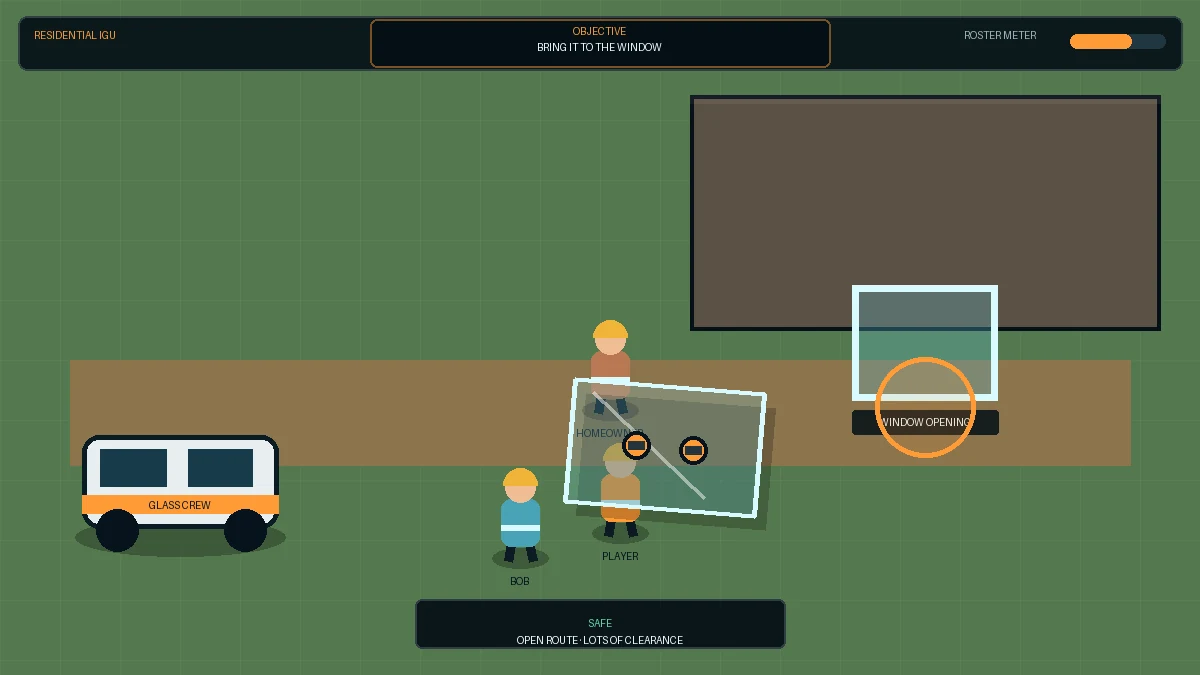
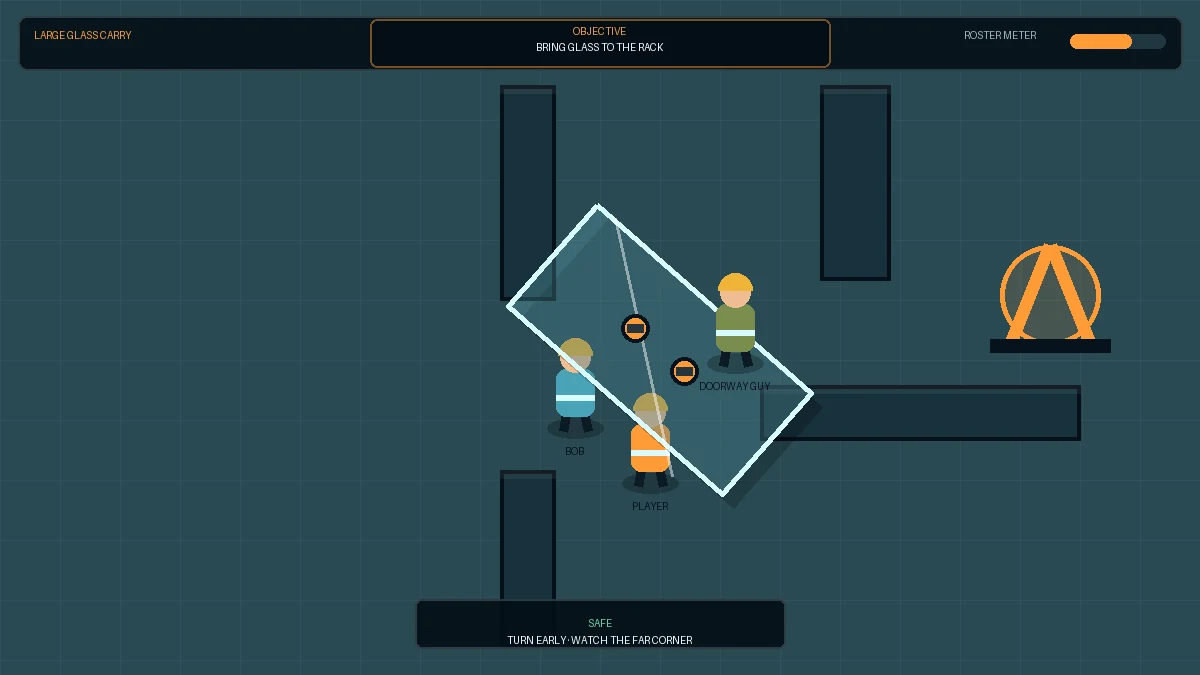
Inspect a visibly fogged insulated glass unit, measure width and height, choose the clearly marked replacement, attach cups, carry it across an open yard and set it into the window.
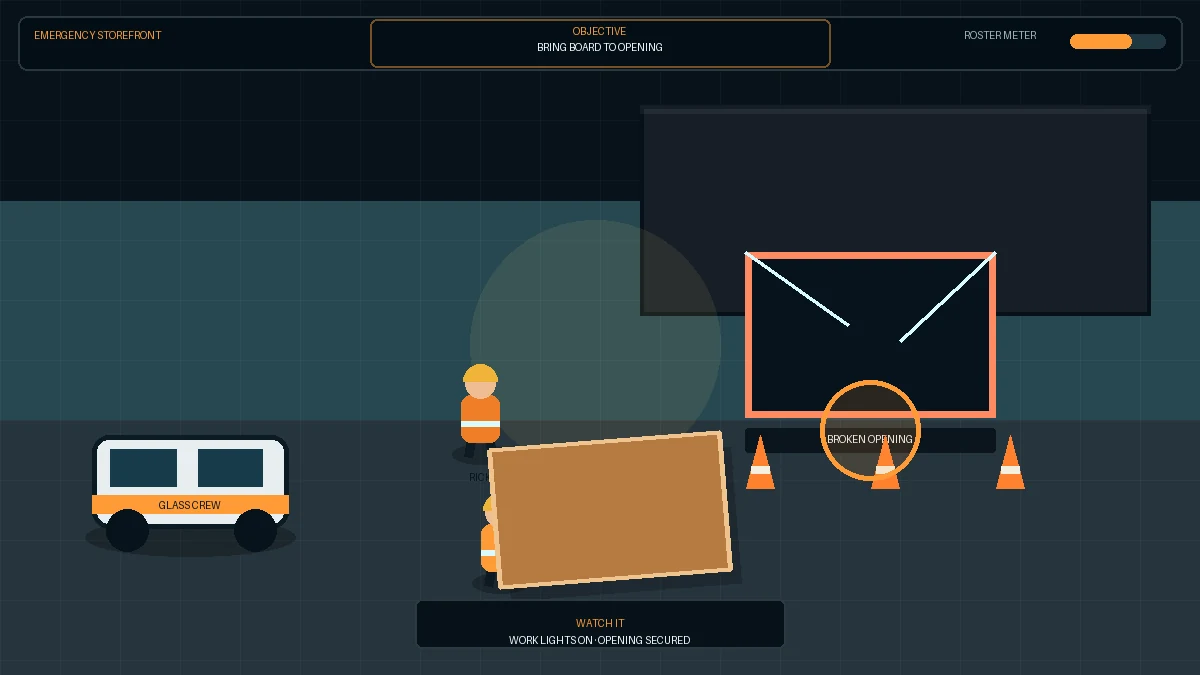
Set cones, clear loose glass in one sweep, measure the opening, install a temporary board and return when replacement storefront glass arrives.
Rotate a large lite through a generous doorway and around a ninety-degree corner. The geometry matters, but the route is designed to be readable and fair.
Work with a simplified two-person carry, align a storefront lite, install stops, seal the perimeter and leave a clear finished opening.
Measure, retrieve a tempered panel, carry it through a compact bathroom, level it, secure the hardware, apply silicone and clean the glass.
Guide a marked panel from a protected floor, align it against a city backdrop, secure it, finish the seal and complete a final inspection.
Finishing the story unlocks a short deterministic challenge. The date controls the glass size, obstacle arrangement and target time. The game records only your personal best and streak on this device; it does not invent a global leaderboard.
The mechanics are simplified for play, but the objects and sequence are recognizable to window installers and glaziers.
Large, smooth glass is awkward to grip safely by its edges. In the game, suction cups create clear handles before a carry begins. A cup is placed inside a broad valid area and pumped until its indicator fills. Real crews inspect and use lifting equipment according to the manufacturer, the glass condition and the job plan; the game deliberately avoids pretending that a few taps reproduce those safety decisions.
Glass size changes how a lite turns. Small glass rotates quickly. Medium glass uses the normal carry speed. Large and very large pieces rotate more slowly and may show a second worker at the opposite handle. That coworker follows the glass rather than becoming an obstacle or a pathfinding test.
Window glass replacement begins with a usable opening measurement and an understanding of the frame or glazing system. The measuring mini-game fixes one end of a tape and lets the player drag the other toward the jamb or frame reference. Readings appear as practical fractional inches, rounded to the precision required by that job. No arithmetic quiz interrupts the action.
The residential job measures both width and height of a fogged IGU. The storefront board-up measures the opening before a temporary panel is carried over. Shower glass uses a wide tolerance and a visible level indicator because the game is teaching sequence and positioning, not issuing fabrication dimensions.
An insulated glass unit, commonly shortened to IGU, contains multiple panes separated by a sealed spacer. When that seal fails, moisture can appear between the panes as fogging or condensation that cannot be cleaned from either exposed surface. The first job makes that failure visible, then clears the window after the replacement is installed and cleaned.
The final actions compress a much larger real process into a few understandable steps: set the glass, install stops or retaining components, seal where the simplified job calls for it, and clean the finished unit. Setting blocks and support components are represented visually, but the game does not claim to be installation instruction.
Commercial storefront work often combines glass, aluminum framing, doors, stops, fasteners, gaskets or sealant. The emergency scene begins with site control: cones and work lights make the broken opening obvious. One sweeping action removes the loose debris, then a board is measured, positioned and fastened. A short time transition brings the replacement glass.
The later commercial installation reuses the same handling skills without burying the player under new controls. Cups, two-person pickup, carry, alignment, setting, stops, seal and clean form a compact glass installation game loop.
The shower job uses a tempered panel, visible hardware and a simple level bubble. The installation zone is deliberately generous: movement adjusts position, rotation adjusts angle and the panel snaps softly when it is close. Hardware and silicone are represented as short follow-up actions rather than dozens of repetitive fasteners.
Architectural glass covers many systems and applications. This game samples only a few: residential windows, commercial storefronts, shower enclosures, glass doors and high-rise facade panels. It does not collapse every system into one pretend universal procedure.
Window wall and curtain wall are distinct facade approaches, even though both can put large areas of glass and aluminum on tall buildings. The high-rise scene is described as window-wall style work and keeps the player on a protected platform or floor. There is no falling-off-the-building mechanic. Height comes from the moving clouds, street depth and skyline while the playable work remains guiding, aligning, securing, sealing and inspecting a marked panel.
Actual high-rise installation depends on engineered systems, site procedures, access equipment and trained crews. The scene is a stylized simulator level, not a substitute for trade instruction or site-specific safety requirements.
It is a playable glazier simulator built around movement and short physical tasks. You carry and rotate glass, drag a tape, place suction cups, position panels and complete finishing actions. There are no multiple-choice trade questions.
Yes. The mobile layout uses a virtual analog joystick and a large contextual Action button. Rotation buttons appear while glass is being carried. Pointer Events allow movement and actions to work with two simultaneous touches.
Use WASD or the arrow keys to move, Space for the current action, Q and E to rotate carried glass, and Escape to pause. The current objective and action verb stay visible in the game.
No. It uses recognizable terminology, objects and work sequences, but it simplifies every procedure for entertainment. Real glazing requires training, appropriate protective equipment, manufacturer instructions, engineered details and site-specific safety planning.
The game restarts from a recent checkpoint, normally just before pickup. Repeated failures quietly increase alignment and collision assistance. You never have to replay old dialogue or refresh the page to recover.
No. The current date creates the same local challenge for that day, while personal best and streak data remain in your browser. The game does not display fake worldwide scores or player counts.
A fogged IGU has moisture or haze between its panes after the edge seal system has failed. Because the moisture is inside the sealed unit, wiping the room-side or exterior surface does not remove it.
The story follows a new worker trying to earn a permanent crew spot. Rick, the foreman, is not big on speeches. His invitation to return Monday is the closest thing to a hiring ceremony.